 Skip to main content Skip to footer
Mounting Position
Hydrogen is 14.37× lighter than air and accumulates beneath the ceilings of rooms and enclosures. For ambient leak detection, the sensor must be installed in the upper part of the space. For inline monitoring in a pipeline, the mounting position is determined by the gas flow direction.
Hydrogen Leak Detector
The industrial hydrogen leak detector from Archigas is engineered as an inline measurement component for continuous integrity monitoring of hydrogen systems, including hazardous and explosive atmospheres.
The detector is designed for direct OEM integration into process circuits that require fast, reliable H₂ concentration control. It operates at pressures up to 200 barg and requires no sample conditioning.
Certifications & Standards
Archigas products meet high standards of reliability, quality, and safety, as confirmed by the following certifications.

ATEX Zone 1 (II 2 G Ex db IIC T4/T3 Gb, -40°C to +90°C/+125°C)
Certification for use in potentially explosive atmospheres

IECEx
International conformity certificate for explosive atmospheres

UL HazLoc
Certification for USA (hazardous locations)

CE
Compliance with European Union requirements

ISO 9001:2015
Certified quality management system
Hydrogen Leak Detector TCD3000: Design & Operating Principle
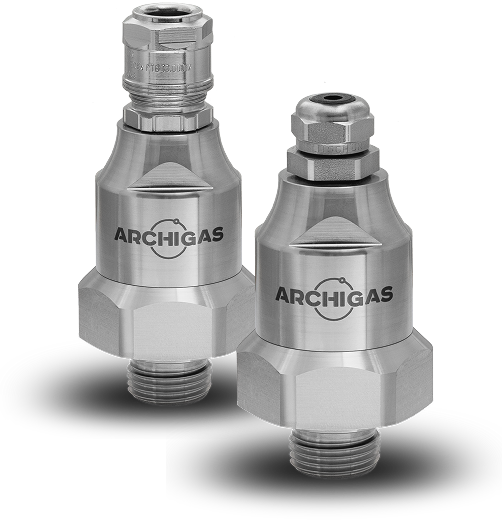
Hydrogen leak detectors TCD3000 Si and Sia are housed in an ultra-compact monobloc enclosure, enabling integration even in space-constrained installations. Sensors do not require gas extraction from the system to detect leaks, are resistant to high pressure and moisture, and maintain a stable zero point.
TCD3000 SiA

TCD3000 Si
How It Works
The operating principle is based on the direct measurement of gas thermal conductivity – an approach that allows hydrogen to be monitored directly within the system, without external bypass lines or bulky sample-conditioning equipment.
H₂ concentration data is transmitted via onboard interfaces directly to the control system, making the sensor straightforward to integrate in OEM applications and industrial automation environments.

How It Works
The operating principle is based on the direct measurement of gas thermal conductivity – an approach that allows hydrogen to be monitored directly within the system, without external bypass lines or bulky sample-conditioning equipment.
H₂ concentration data is transmitted via onboard interfaces directly to the control system, making the sensor straightforward to integrate in OEM applications and industrial automation environments.
TCD3000 Product Variants
Archigas offers two versions of its industrial hydrogen gas leak detector. Both are built on the same TCD measurement principle and serve a single purpose — continuous hydrogen leak monitoring within a process or laboratory workflow.
The difference lies in the area classification requirements:
- TCD3000 SiA — designed for use in explosive atmospheres; ATEX Zone 1 certified (Ex db IIC T4/T3 Gb).
- TCD3000 Si — for use in standard industrial environments.
Specifications by Model →
Parameter | TCD3000 SiA | TCD3000 Si |
|---|---|---|
Hazardous area certification | ATEX Zone 1 (II 2 G Ex db IIC T4/T3 Gb), IECEx | - |
Ambient temperature range | -40 to +90 °C / +120 °C | -40 to +80 °C |
Dimensions (with connectors) | H: 96 mm; Ø: 45 mm | H: 91 mm; Ø: 45 mm |
Weight | 740 g | 440 g |
Factory Calibration
Archigas offers two versions of its industrial hydrogen gas leak detector. Both are built on the same TCD measurement principle and serve a single purpose — continuous hydrogen leak monitoring within a process or laboratory workflow.
Key Specifications
Parameter | Value |
|---|---|
Reaction time | 30 ms |
Warm-up time | < 1 min |
Measurement range | ppm-level → 100 vol.% H₂ |
Process gas pressure | 0.9…200 barg (abs.) |
Process gas temperature | up to +125 °C |
Process gas flow | 0…10 m/s |
Moisture resistance | Condensate and liquid contact does not damage the sensor |
Analog output | 4–20 mA, RL ≤750 Ω |
Power supply | 24±25% VDC, <5 W |
Interface | RS485 (38400 baud) |
Service life | Up to 10 years |
Why You Can Trust Archigas Detectors
8+
global distribution partners
25+
customer countries reached
125+
B2B and industrial companies served
400+
customer projects supplied
Key Benefits of the Hydrogen Leak Detector by Archigas
The features that set the TCD3000 SiA and TCD3000 Si apart from standard hydrogen gas leak detectors:
Archigas hydrogen sensors are specified when the requirement is not simply detection, but precise H₂ measurement under conditions where catalytic and electrochemical sensors rapidly lose performance. For OEM and skid integration, this translates into more predictable sensor behavior in real process conditions.
In an industrial system, this offers three practical advantages: compact integration, high-pressure operation, and fast signal formation. For the design engineer, it means sensor behavior that holds up in the field – not just in the lab. The hydrogen gas leak detector by Archigas is also resistant to moisture and condensate, maintaining accuracy where standard sensors quickly lose their factory calibration.
Get a Quote for Your Configuration
Pricing depends on the model variant, measurement range, and integration requirements. Provide your process parameters, and we will prepare a tailored proposal within one business day.
Hydrogen Leak Detection: TCD vs. Other Methods
Electrochemical and catalytic sensors depend on gas diffusion to the sensing element, which introduces a response delay of 5 to 60 seconds. Infrared analyzers are physically unable to measure H₂ directly due to the absence of IR activity in the hydrogen molecule. The TCD principle is based on the difference in thermal conductivity between gases: hydrogen has approximately 7× the thermal conductivity of air or nitrogen.
Parameter | TCD (Archigas) | Electrochemical | Catalytic | IR analyzer |
|---|---|---|---|---|
T90 response time | < 1 s | 10…60 s | 5…30 s | 2…10 s |
Operating pressure | Up to 200 barg | Typically atmospheric | Typically atmospheric | Typically atmospheric |
Humidity influence | Low | Drift, poisoning | Drift | Condensate on optics |
Mixture-specific calibration | Yes (factory) | Limited | Limited | Limited |
ATEX Zone 1 certification | Yes (TCD3000 SiA) | Rarely | Rarely | Rarely |
Best for | Inline, continuous H₂ leak & concentration monitoring; LEL/UEL alarm; works under pressure & humidity | Portable/personal H₂ detectors at low ppm | Area monitoring at low cost | Open-path or trace-level H₂ in some R&D contexts |
Limitations for H₂ | Requires a binary or quasi-binary mixture for absolute accuracy | Short lifetime (1–2 years); slow response; affected by temperature & humidity | Sensor poisoning (silicones, sulfur); needs O₂; drift; not suitable inline | Not suitable for direct H₂ measurement (H₂ molecule has virtually no IR activity); high cost; limited installation base for H₂ |
Among the methods reviewed, TCD is the only approach that combines all the characteristics required for demanding industrial environments where inline measurement, operation under pressure, and the absence of a sample extraction system are non-negotiable. This is why Archigas chose TCD technology as the foundation for both the TCD3000 SiA and TCD3000 Si.

Prof. Dr. rer. Nat. habil. Friedemann Völklein
RheinMain University of Applied Sciences
Chief Scientific Advisor and Design Development
Chief Scientific Advisor and Design Development
"In projects with high pressure and variable humidity, we found that standard hydrogen sensors require frequent recalibration. Archigas TCD analyzers delivered a stable signal even when mounted directly in a high-pressure line, with no bypass. This allowed us to reduce the response time of our hydrogen leak detection system from several seconds to the sub-second range."
Industrial Applications of the Hydrogen Leak Detector TCD3000 SiA and TCD3000 Si
Hydrogen gas leak detectors from Archigas are deployed in process and laboratory environments requiring continuous hydrogen leak monitoring in the working medium. Each application scenario involves building a hydrogen gas leak detection system directly into the process circuit without gas extraction or additional sample conditioning.
Describe your process conditions – pressure, gas composition, installation zone. An Archigas engineer will prepare a configuration and commercial proposal within 2–3 business days.
Installation & Integration
Need Integration Support?
Embedding a TCD sensor in an existing line requires careful consideration of pressure, gas temperature, background mixture composition, installation zone, and other factors. Contact an Archigas engineer, and we will define the right configuration for your process diagram.
Tom Burkard
Archigas engineer

Clients and Partners


FAQ
How do I choose a hydrogen leak detector?
When selecting a hydrogen leak detector, the primary factors to consider are system pressure, required measurement range, background gas composition, and operating environment. For standard applications, the TCD3000 Si is the optimal choice. For more demanding conditions such as pressures up to 200 barg, humid environments, or high explosion risk – the TCD3000 SiA with ATEX Zone 1 certification should be considered. Archigas provides individual factory calibration for your specific binary gas mixture.
What determines the hydrogen leak detector price?
Pricing depends on the model variant, measurement range, area classification requirements, and integration parameters. Cost is calculated individually based on the project specification.
Is the module suitable for continuous leak monitoring?
Yes. The T90 response time of
Does the process need to be stopped for installation?
The module threads into a standard fitting (G 1/2" or NPT 1/2"). It is necessary to locally depressurize the installation section before mounting.
When do standard hydrogen leak detection methods fail?
When building a hydrogen gas leak detection system under high pressure, in a humid environment, or in a hazardous area, conventional approaches have inherent design limitations: catalytic sensors lose sensitivity on contact with sulfides and silicones; electrochemical sensors are not rated for above-atmospheric pressure and degrade within 1–2 years; optical sensors cannot distinguish H₂ in a methane-containing mixture. In these conditions, TCD remains the only method suitable for continuous inline monitoring without additional infrastructure.
How often is servicing required?
The recommended recalibration interval is every 6 months, performed by the user.
Get a Configuration for Your Application
Engineering consultation on model selection, calibration for your gas mixture, and system integration conditions.
